
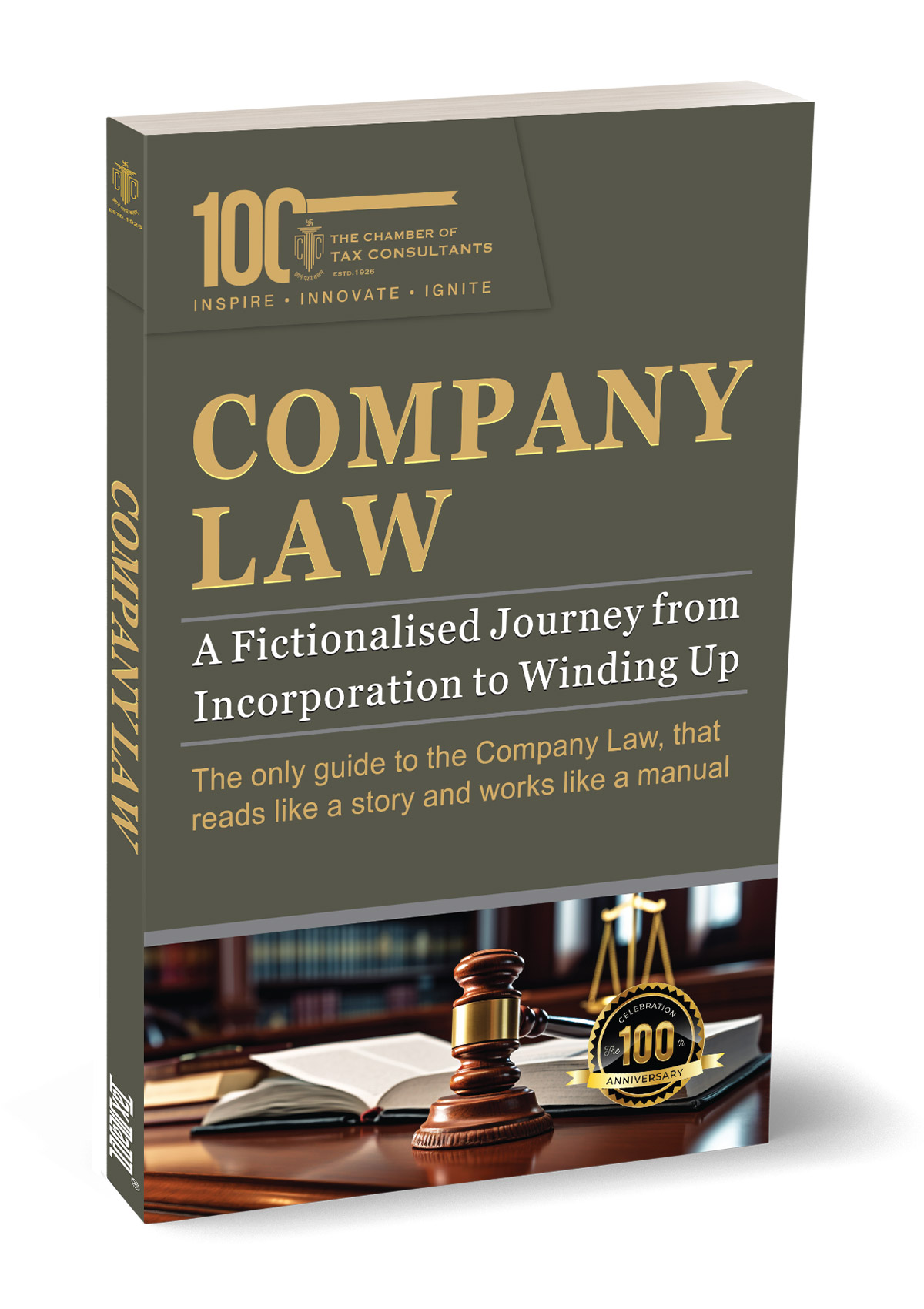
Company Law — A Fictionalised Journey from Incorporation to Winding Up By The Chamber of Tax Consultants, Sristi Nimodia
Original price was: ₹495.00.₹396.00Current price is: ₹396.00.
For decades, company law in India has been viewed by many as a daunting obstacle—a statute filled with provisos, cross-references, and technical definitions that intimidate entrepreneurs before they even begin. The result, as the author notes, is a damaging irony: the very legal framework meant to promote enterprise is often the one most feared by those seeking to build it.
This book breaks away from that tradition entirely.
Company Law — A Fictionalised Journey from Incorporation to Winding Up follows Ayush—a sole proprietor of a growing tea business, operating from the 6th floor of Sikaria Compound on GS Road in Guwahati—who decides it is time to incorporate and advance his enterprise. From that initial act of ambition, the reader accompanies him through the full cycle of a company’s legal life under the Companies Act 2013: choosing a corporate structure, drafting foundational documents, incorporating, raising capital, governance, director management, accounts and audit, fraud investigation, oppression and mismanagement, mergers, and ultimately, the formal winding-up of the company.
All legal concepts are introduced not through academic exposition but via Ayush’s conversations—with a childhood friend who has established an OPC, with his lawyer drafting the MoA, with a former classmate who just completed an IPO, with an SFIO officer explaining financial fraud, with a cousin who is a managing director of a major firm, and with a legal executive at a fintech company being sued for mismanagement. Law surfaces through dialogue—from breakfast chats, airport pickups, WhatsApp calls, and hotel restaurant dinners. It never presents itself as a lecture.
Despite this, the book is not a loose narrative. Each concept is tied to a specific section of the Companies Act 2013, footnoted throughout. Comparisons are presented in tables. Procedural steps are laid out in sequence. Part Three—covering Offences and Penalties, E-Forms, and a Comparative Schedule—serves as a standalone compliance manual. The resulting work is a book you read and a manual you revisit, genuinely and equally.
The closing image of the book is intentionally structured: Ayush is back at the same window of his office on the 6th floor of Sikaria Compound, gazing at the same street where his journey began. But now, the legal complexity he once feared forms the framework of his ambition. The circle is complete.
This book is designed for a wide but well-defined audience:
- Entrepreneurs and Business Founders who need to understand the Companies Act 2013 as it applies to their enterprise at every stage—from the moment of incorporation to dividend payments, director appointments, and beyond—but who do not have the time or inclination for a traditional legal commentary
- Advocates, Company Secretaries, Chartered Accountants, and Compliance Officers who want a compact, narrative-led orientation to the full corporate lifecycle, particularly useful for client counselling, onboarding junior staff, or refreshing foundational knowledge
- Law and Commerce Students preparing for professional examinations or academic courses in corporate law, who benefit from a conversational treatment of the statute before engaging with case law or formal commentary
- Independent Directors and Board Members who require a working understanding of their duties, liabilities, and procedural obligations without having to wade through the Act itself
- Anyone Transitioning from a Sole Proprietorship, Partnership, or LLP into a Corporate Structure, and who needs to understand precisely what changes—and what is now required of them, under the Companies Act 2013
The Present Publication is the Latest Edition, commissioned by The Chambers of Tax Consultants and published exclusively by Taxmann. It is authored by Advocate Sristi Nimodia and reviewed by CS Latesh Shah. The key points of this book are as follows:
- [Narrative-led Legal Education] The entire book is structured around the journey of Ayush and his tea business. Legal concepts emerge naturally from his conversations with friends, legal advisors, and professionals, making abstract statutory provisions concrete, memorable, and immediately applicable. This is not storytelling as a gimmick; it is storytelling as pedagogy
- [Complete Corporate Lifecycle Coverage] From the first decision about business structure to the final dissolution of a company, every major stage of a company’s legal existence is addressed in sequence. No other compact guide covers this complete arc in a single, coherent narrative
- [Strict Statutory Accuracy] Despite its accessible tone, the book never sacrifices legal precision. Every concept discussed is anchored to specific sections of the Companies Act 2013, cited in footnotes throughout. The language is simple; the legal foundation is meticulous
- [Exhaustive Penalty and Offence Reference Tables] Part Three contains a comprehensive, tabulated compilation of offences and their corresponding penalties under the Companies Act 2013—covering penalties from prospectus violations, securities defaults, and deposit contraventions, through to board governance failures and fraud. This section alone functions as a standalone compliance risk reference
- [Complete E-Forms Directory] A dedicated chapter catalogues the e-forms prescribed under the Companies Act 2013, aligned to the relevant compliance obligations discussed in the narrative. Practitioners can cross-reference the story with the actual filing requirements, giving the book its ‘works like a manual’ quality
- [Comparative Reference: Company vs. LLP] An integrated schedule (Chapter 25) provides a structured comparison between a Company and a Limited Liability Partnership—covering structural, governance, liability, and compliance differences—directly relevant to the foundational decision every entrepreneur must make before incorporation
- [Author’s Unique Interdisciplinary Grounding] Advocate Sristi Nimodia brings an unusual combination of credentials: a mathematics honours degree, actuarial science certification from the Institute and Faculty of Actuaries (UK), an LLM in Investment and Securities Law from NISM, and active legal practice. This produces a treatment of corporate law that is analytically sharp, financially literate, and practically oriented—not merely doctrinal
The coverage of the book is as follows:
- Part One — Foundation and Capital (Chapters 1–10) | This section covers the entire pre-operational and capital-formation phase of a company’s life:
- Chapter 1 — The Roller Coaster Begins
- Types of companies (Public, Private, OPC), minimum membership requirements, categories of members, liability structures (limited by shares, limited by guarantee, unlimited), and the OPC nominee framework
- Chapter 2 — The Company’s DNA
- Memorandum of Association (MoA) and Articles of Association (AoA)—their purpose, content, legal standing, and alteration
- Chapter 3 — The Birth Certificate
- Incorporation procedures, the role of the Registrar of Companies (RoC), fraud liability at the formation stage, and Director Identification Numbers (DIN) and Corporate Identity Numbers (CIN)
- Chapter 4 — Corporate Identity
- Registered office requirements, statutory records, company name rules, and permissible alterations to corporate identity
- Chapter 5 — Public vs. Private
- Rules governing capital raising across company types—the distinction between public offers and private placements
- Chapter 6 — The Company’s Public Face
- Prospectus—mandatory disclosures, misstatement liability, and investor protection provisions
- Chapter 7 — Ownership Unpacked
- Equity shares, preference shares, rights issues—the architecture of share capital
- Chapter 8 — Market vs. Books
- Company valuation concepts—market value versus book value, relevant for share pricing and capital decisions
- Chapter 9 — The Share Lifecycle
- Share alterations, transfer and transmission of securities, buybacks, and the Register of Members
- Chapter 10 — The Borrowing Landscape
- Debentures, deposits, charges, and the regulatory framework for debt financing under the Act
- Chapter 1 — The Roller Coaster Begins
- Part Two — Governance and Enforcement (Chapters 11–22) | This section addresses the ongoing compliance obligations of a functioning company:
- Chapter 11 — Corporate Housekeeping
- Statutory registers, records maintenance, and the compliance architecture a company must sustain
- Chapter 12 — Governance in Session
- Rules for member meetings—AGMs, EGMs, quorum, resolutions, voting mechanisms, and notice requirements
- Chapter 13 — From Profit to Payment
- The dividend lifecycle—declaration, payment timelines, Unpaid Dividend Account obligations, and default consequences
- Chapter 14 — The Financial Mandate
- Accounts preparation, financial statement requirements, auditor appointment, audit procedures, and the National Financial Reporting Authority (NFRA)
- Chapter 15 — The Guiding Force
- Director appointment rules—eligibility, disqualifications, DIN, independent directors, and women director requirements
- Chapter 16 — The Director’s Cycle
- Director tenure, vacation of office, resignation, and removal procedures
- Chapter 17 — The Board in Session
- Board meeting rules — frequency, quorum, notice, resolutions by circulation, and committee governance.
- Chapter 18 — Executive Pay
- KMP appointment, tenure, and managerial remuneration limits and approval requirements
- Chapter 19 — The Red Flag Rules
- Regulatory inspection powers, investigation into fraud, Serious Fraud Investigation Office (SFIO) jurisdiction, and the strike-off procedure for defunct companies
- Chapter 20 — Corporate Transformation
- Merger, amalgamation, and court/NCLT-approved schemes of arrangement
- Chapter 21 — The Minority’s Fight
- Oppression and mismanagement—shareholder rights, NCLT remedies, and protection of minority interests
- Chapter 22 — The Final Curtain
- Liquidation and dissolution—voluntary winding up, NCLT-ordered winding up, the role of the liquidator, and the legal conclusion of a company’s existence
- Chapter 11 — Corporate Housekeeping
- Part Three — Appendices and Reference (Chapters 23–25)
- Chapter 23 — Offences and Penalties
- A comprehensive, tabulated reference mapping violations to their statutory penalties across the full Act—imprisonment terms, fines per company and per officer, and continuing default penalties
- Chapter 24 — E-Forms under the Companies Act 2013
- A structured directory of all prescribed e-forms referenced across the compliance obligations discussed in the narrative
- Chapter 25 — Schedule
- Comparative analysis of Company vs. Limited Liability Partnership across structural, governance, and compliance dimensions
- Chapter 23 — Offences and Penalties
The structure of the book is as follows:
- Chronological Architecture — The book’s structure mirrors the temporal sequence of a company’s existence. Incorporation law comes before governance law; governance law comes before enforcement and insolvency. No concept is introduced before it is needed, and no knowledge is assumed
- Law in the Order It Becomes Relevant — Ayush’s journey is not a random walk through the statute. Each chapter addresses what a founder would actually face next—from choosing a structure, to drafting documents, to raising capital, to governing a board, to understanding what regulatory intervention looks like. The reader absorbs the law as a practising entrepreneur would encounter it
- Consistent Chapter-Level Structure — Every chapter follows the same internal pattern:
- A dramatic or conversational opening that establishes the context and introduces the character through whom the law will be taught
- The law delivered through dialogue and supported by narrative
- Tables and comparative charts appearing at the precise point Ayush himself would need to organise the information
- Footnotes at the bottom of each page citing the exact statutory provision under discussion
- No Summaries | Only Forward Motion — Each chapter ends not with a recap but with Ayush—having absorbed what he needed—ready to move to the next stage. The narrative drives the reader forward rather than pausing to consolidate
- Three Modes of Reading Built Into One Book — The three-part structure—Foundation and Capital / Governance and Enforcement/Appendices and Reference—supports three distinct reading modes simultaneously:
- Sequential reading for a first-time founder following Ayush’s full journey
- Selective navigation for a practitioner who needs a specific stage or topic
- Reference lookup for a professional who needs the penalty table, an e-form, or the Company vs. LLP comparison at short notice
| ISBN | 9789375617778 |
|---|---|
| Edition | 2026 |
| Binding | Paperback |
| Authors | Sristi Nimodia, The Chamber Of Tax Consultants |
Related products