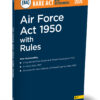
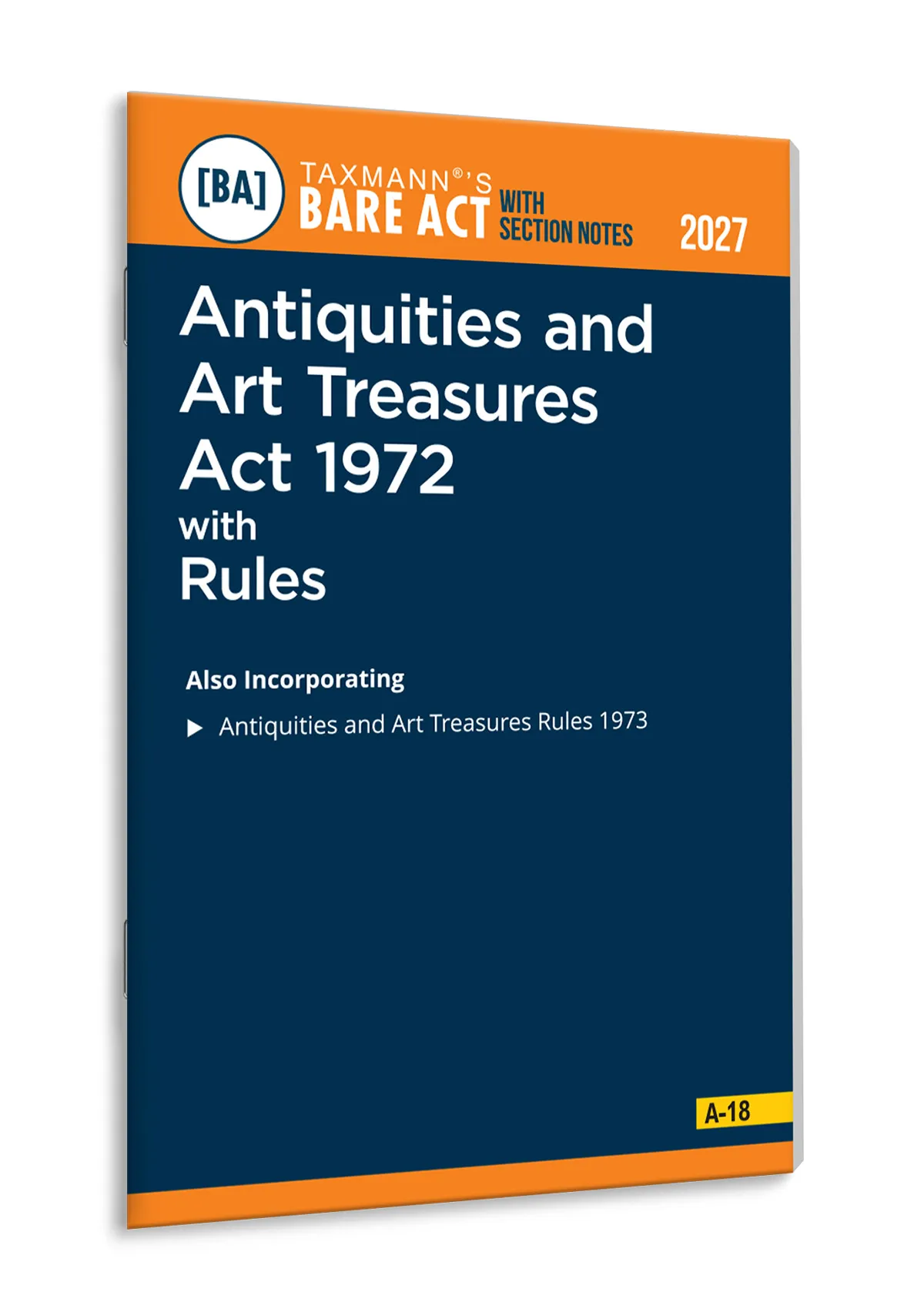
Antiquities and Art Treasures Act 1972 with Rules – Bare Act with Section Notes By Taxmann’s Editorial Board
Original price was: ₹95.00.₹75.00Current price is: ₹75.00.
Antiquities and Art Treasures Act 1972 with Rules [Bare Act with Section Notes] by Taxmann is a single-volume working Edition of the Act and its Rules of 1973, with Section Notes printed under three sections of the Act and case law under one. The statutory text is freely available; what this book supplies is the apparatus around it—Section Notes, with sub-notes, that break down the definitions of ‘antiquity’ and ‘art treasure’, the three penalties in section 25 and the liability of companies in section 28; a summary of a ruling on coins and registration under section 14; twenty-seven footnotes that record the amendments to the Act and the Rules, ten of them with the earlier wording; and a Subject Index to every section of the Act and to the six definitions in section 2.
The book solves a practical problem. Anyone working under the Act has to piece together five things:
- The text of the Act, as amended in 1976
- The text of the Rules, as amended by five sets of Amendment Rules between 1978 and 1992
- The wording the amendments replaced
- The dates on which the Act came into force, in Sikkim and in the rest of India
- The laws that have replaced the Arbitration Act 1940 and the Code of Criminal Procedure 1898
This volume prints the first two with the amendments marked in square brackets. Its footnotes give the earlier wording in ten places, the commencement dates and the successor laws.
This book is intended for the following audience:
- Antique Dealers and Auction Houses who need the licence required by section 5 and must keep the register, photo albums, monthly returns and declarations of stock prescribed in rules 6 to 9 and Forms III to VI
- Collectors and Owners of Antiquities who must register notified antiquities under section 14, obtain a certificate under section 16 and report any transfer under section 17, using Forms VII to IX
- Museums, Archives and Cultural Institutions covered by the exemption in section 18 where they are owned, controlled or managed by the Government, a local authority or an approved body
- Exporters, Shippers and Customs Officers who need the export ban in section 3, the application of the Customs Act 1962 by section 4 and the export permits that rule 3 places with the Director-General
- Archaeological Survey of India Officers who decide under section 24 whether an article is an antiquity or an art treasure, hear appeals under rule 14 and sanction prosecutions for illegal export under rule 15
- Licensing, Registering and Authorised Officers who grant, renew, amend, suspend and revoke licences under sections 8 to 11, register antiquities under section 16, inspect records under section 10 and enter, search and seize under section 23
- Owners Facing Compulsory Acquisition and their Advisers working with the order and representation procedure of section 19, the compensation factors and arbitration of section 20 and the appeal to the High Court under section 22
- Advocates, Prosecutors and Investigating Officers handling the three penalties of section 25, the sanction and complaint required by section 26 and the offences by companies in section 28, with the ruling on the prosecution of a coin collector
- Law, History and Archaeology Students and Exam Aspirants who want the Act, the Rules, the notes and the ruling in one current volume
The Present Publication is the 2027 Edition, covering the amended text of the Antiquities and Art Treasures Act 1972 [Act No. 52 of 1972] and the Antiquities and Art Treasures Rules 1973, with the law stated as updated till 20th September 2026. It has the following noteworthy features:
- [Section Notes – The Core Editorial Feature] Eight numbered notes are printed under sections 2, 25 and 28, and three of them divide into five sub-notes. Each note has a numbered head, and most break the provision into italic sub-heads, points and sub-points, so the elements of a definition, an offence or a defence are set out as separate points
- [Two Definitions Explained] Notes 2.1 and 2.2 explain ‘antiquity’ and ‘art treasure’. Sub-notes 2.1-1 and 2.1-2 take objects and documents separately, and give the two age tests of one hundred and seventy-five years. The note on ‘art treasure’ sets out the declaration by notification, the regard to artistic or aesthetic value and the bar on any declaration while the author is alive
- [Three Penalties Broken Down] Notes 25.1 to 25.3 take the three penalties of section 25 one at a time—illegal export, breach of sections 5, 12, 13(2), 13(3), 14 and 17, and obstruction of officers. Under italic sub-heads, each note sets out the conduct caught and the punishment it carries. Note 25.1 adds the modes of commission and the link with the Customs Act, and note 25.2 the confiscation of the antiquity
- [Company Liability Explained] Notes 28.1 to 28.3 set out who is deemed guilty when a company offends—the company and every person in charge of, or responsible to, it for its business—the two defences open to those persons, the liability of directors, managers, secretaries and other officers for consent, connivance or neglect, and the section’s own meanings of ‘company’ and ‘director’
- [Case Law on Registration Under Section 14] A summary of one ruling is printed under section 14: Sumeet Arora v. State (reported in 2008), in which the Jammu and Kashmir High Court held that mere possession of antiquities is not punishable in itself, and noted that coins had been taken out of registration by a later notification. It quashed the prosecution under the Act alone. The summary opens with a bold head naming the issue and closes with the citation
- [Amendments Footnoted, with the Earlier Wording] Three footnotes to the Act record the changes made by the Amendment Act of 1976, with retrospective effect from 4th June 1976. Twenty-four footnotes to the Rules record five sets of Amendment Rules, made in 1978, 1979, 1981, 1983 and 1992. Ten of the twenty-seven give the wording replaced or omitted, including the earlier licence fee of one hundred rupees and renewal fee of fifty rupees
- [Dates and Notifications Recorded] Footnotes give the date of the Act, 9th September 1972, and its commencement on 5th April 1976 throughout India except Sikkim, where it came into force in two stages, on 1st June 1979 and 15th April 1980, each with its notification. The Rules carry their notification, G.S.R. 405(E) of 31st August 1973
- [Successor Laws Footnoted] Three footnotes point from repealed laws to the laws now in force: from the Arbitration Act 1940 in section 20 to the Arbitration and Conciliation Act 1996, and from the Code of Criminal Procedure 1898 in sections 23 and 27 to sections 103 and 23 of the Bharatiya Nagarik Suraksha Sanhita 2023
- [The Rules with All Twelve Forms] The Rules are printed with their twelve Forms, from the application for a licence in Form I to the application for surrender in Form X. They include a seventeen-column register of antiquities in Form IV, two declarations of stock in Forms V and VI, and a transfer of ownership in Form IX with eleven particulars for the seller or giver and nine for the new owner
- [Research Tools] A Contents list gives page references for all thirty-three sections, seventeen rules and twelve Forms. A Subject Index of thirty main heads and eighteen sub-entries refers to every section of the Act and to all six definitions in section 2. Running heads give the last section, rule or Form on each page from the second page of the Act and of the Rules
- [Authoritative Bare Act Presentation] Taxmann’s Bare Act editorial format is followed throughout. A boxed COMMENTS device closes the statutory text wherever editorial matter follows, under four sections, so the words of Parliament are kept apart from the publisher’s notes
The structure of the book is as follows:
- Contents
- Antiquities and Art Treasures Act 1972, with Section Notes and Case Law
- Sections 1 to 33
- Subject Index
- Antiquities and Art Treasures Rules 1973
- Rules 1 to 15, with Rules 2A and 2B
- Forms I to X, with Forms IA and IIA
| ISBN | 9789375613411 |
|---|---|
| Authors | Taxmann's Editorial Board |
| Binding | Paperback |
| Edition | 2026 |
Related products