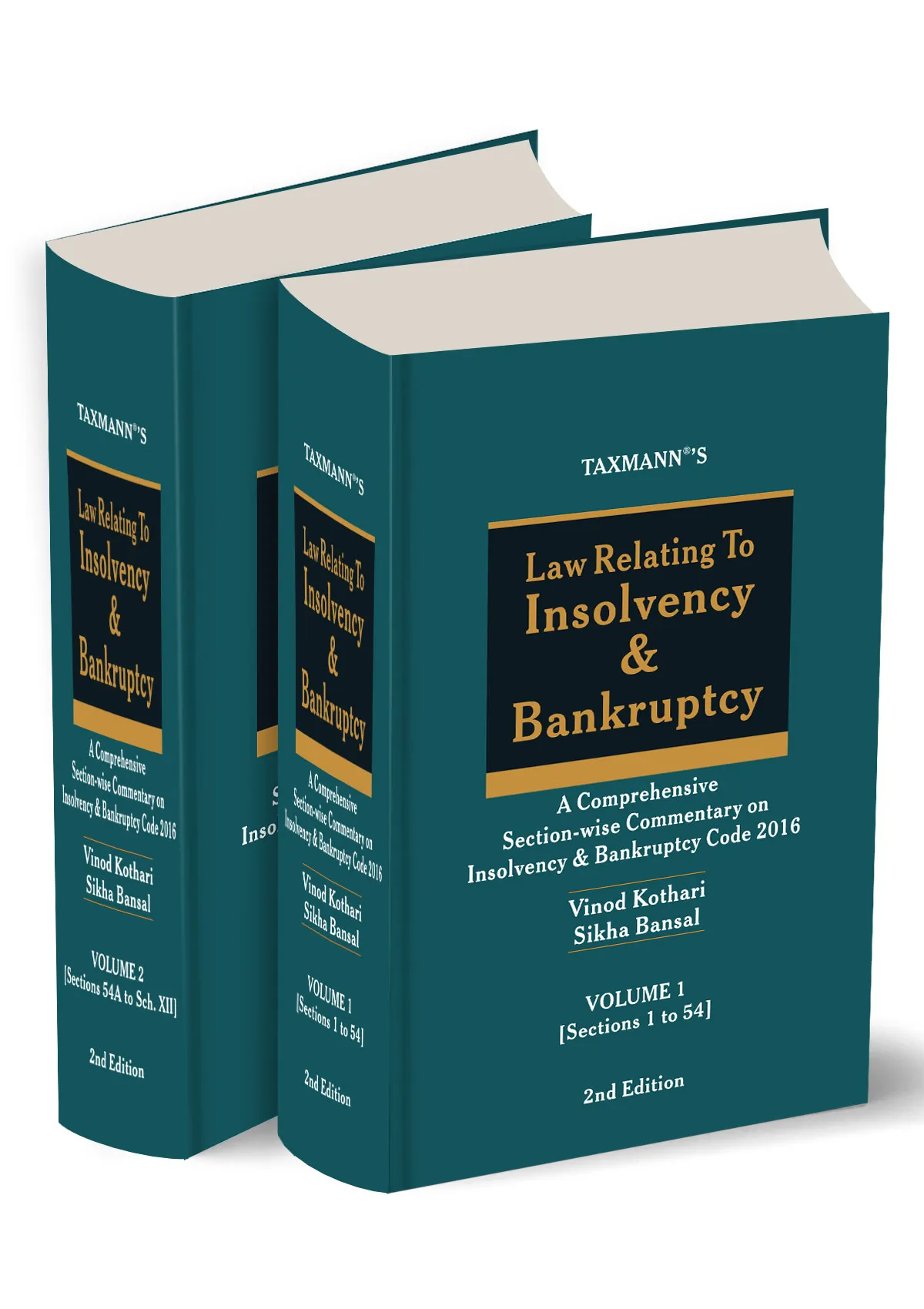
Law Relating to Insolvency & Bankruptcy – A Comprehensive Section-wise Commentary on Insolvency & Bankruptcy Code 2016 By Vinod Kothari, Sikha Bansal
Original price was: ₹8,495.00.₹6,796.00Current price is: ₹6,796.00.
Law Relating to Insolvency & Bankruptcy by Vinod Kothari and Sikha Bansal is a two-volume, section-wise commentary on the Insolvency and Bankruptcy Code 2016, covering every section and Schedule of the Code. Its First Edition came out in 2016, soon after the Code was enacted, and was the first authoritative commentary on the new law.
Published ten years after the first, the Second Edition has been thoroughly revised and enlarged. It takes in the 2026 amendments and a decade of rulings, regulations and practice.
The book is built to be read at two depths. A reader can get a quick read of where a section stands. Or they can follow the full commentary, which tests that position against the rulings, reports and authorities behind it. Written by authors who work in the field as practitioners and scholars, it is a working reference as much as a study text.
This book is intended for the following audience:
- Insolvency Professionals acting as interim resolution professionals, resolution professionals, liquidators and bankruptcy trustees
- Advocates and Legal Counsel handling insolvency matters before tribunals and courts
- Adjudicators at the Adjudicating Authorities and Appellate Tribunals
- Banks, NBFCs, Asset Reconstruction Companies and Other Creditors, including members of committees of creditors
- Companies, Promoters, Directors and Personal Guarantors
- Resolution Applicants, Investors and their Advisers
- Regulators, Policymakers, Academics and Students of insolvency law
The Present Publication is the 2nd Edition, updated till 30th September 2026. It is authored by Vinod Kothari and Sikha Bansal, with the following noteworthy features:
- [Revised for the 2026 Amendments]
- The commentary is revised for the Insolvency and Bankruptcy Code (Amendment) Act 2026 and for the 2026 changes to the CIRP, Liquidation and Personal Guarantor Regulations
- The two chapters added in 2026 get full commentary. So do new concepts such as phase-wise resolution, creditor-initiated insolvency and group insolvency
- Commentary on the omitted Fast Track CIRP provisions and on omitted sections 74 and 76 is kept for reference
- [2,500+ Rulings, Indian and Foreign] The commentary draws on more than 2,500 rulings, up to 2026. Indian rulings span the Supreme Court, High Courts, NCLAT and NCLT benches. Foreign rulings come from courts in the UK, the US, Australia and Singapore, among others
- [International Benchmarks and Scholarship]
- Indian provisions are set beside the UNCITRAL Legislative Guide and Model Laws, the US Bankruptcy Code and the UK Insolvency Act 1986
- The commentary also draws on leading insolvency scholarship, notably Sir Roy Goode’s Principles of Corporate Insolvency Law
- Pre-packs, creditor-initiated resolution, group insolvency and cross-border insolvency each get a separate discussion of precedents in other jurisdictions
- [Legislative Record] The background of each provision is traced through official reports and papers, often quoted in their own words:
- The BLRC Report and the Insolvency Law Committee reports
- Notes on Clauses
- The Select Committee Report on the 2025 Amendment Bill
- MCA and IBBI discussion papers
- [Authors’ Perspective] The authors take clear positions. They reconcile rulings that appear to conflict, point out rulings that need reconsideration, and test the 2026 amendments against their stated purpose
- [Practice Tools] Four annexures give specimen formats that practitioners can adapt:
- A compliance checklist for resolution plans
- A section 29A eligibility questionnaire
- A declaration-cum-undertaking under section 29A
- A declaration of solvency for voluntary liquidation
Each section is generally laid out as follows:
- Statutory Text — The section is reproduced as amended. Footnotes give:
- Its amendment history, with dates of effect
- The earlier wording of substituted or omitted text
- Which 2026 changes are in force and which are yet to be notified
- Overview of Section — After the text, nearly every section has a boxed, bullet-point overview of the provision and its case law. The points carry paragraph pointers, such as [Para 31.2-3], into the detailed comments
- Cross References and 2026 Amendment Notes — Where relevant, a short box lists related sections, rules and regulations. Many sections changed in 2026 also carry a ‘2026 Amendment’ note that sums up what changed
- Comments
- The commentary runs in numbered paragraphs. It usually opens with the overview, purport or intent of the section and then works issue by issue
- Many headings are framed as practical questions, such as ‘Is the moratorium automatic or discretionary?’
- Footnotes give citations, including taxmann.com citations, and web links to source documents
- Authors’ Notes and Practical Guides — The authors’ views appear in the text and in bracketed Authors’ Notes. Practical Guide boxes, Quick Tips and checklists give hands-on pointers on topics such as:
- Public announcements
- Contracts and licences to review during CIRP
- Section 29A verification
- The steps of a voluntary liquidation
- Tables, Figures and Illustrations
- Over 130 tables give side-by-side comparisons (such as CIRP v. CIIRP and IRP v. RP), timelines, applicability grids and case-law digests
- Over 25 flowcharts and diagrams map processes such as the Swiss challenge and the section 53 waterfall
- Worked illustrations show calculations such as a liquidator’s fee and solvency tests on balance-sheet extracts
- Schedules — Notes on the First to Eleventh Schedules go amendment by amendment. Each note gives the provision as it stood, the amendment, and its purpose or impact
| ISBN | 9789375618874 |
|---|---|
| Authors | Sikha Bansal, Vinod Kothari |
| Binding | Hardbound |
| Edition | 2026 |
Related products