Tribunals Reforms Act 2026 – Bare Act with Section Notes By Taxmann’s Editorial Board
Original price was: ₹95.00.₹76.00Current price is: ₹76.00.
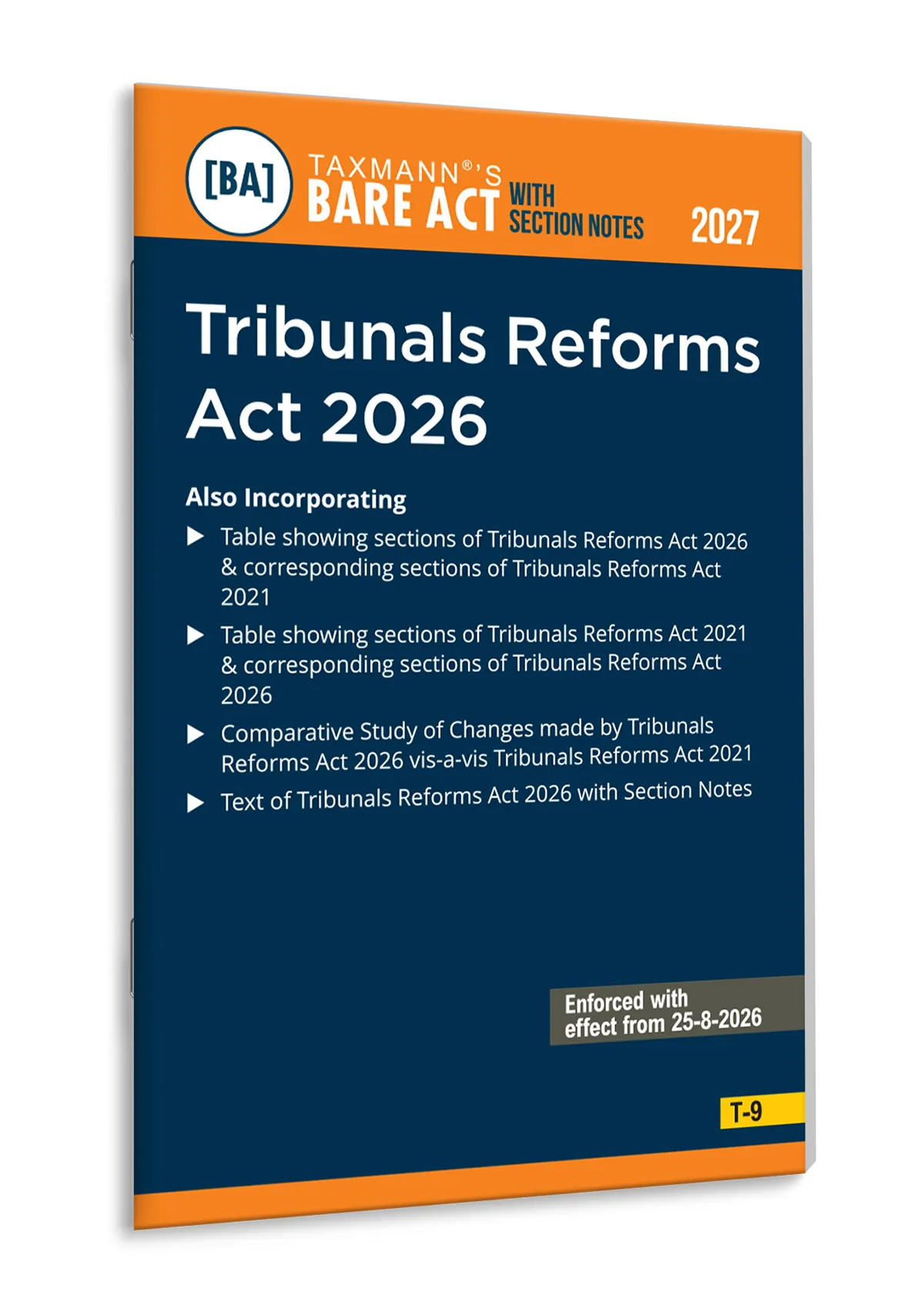
Tribunals Reforms Act 2026 [Bare Act with Section Notes] by Taxmann is a single-volume working edition of the law governing the appointment, tenure and service conditions of Chairpersons and Members of India’s principal Tribunals, assembled for the transition year. The Act—enforced with effect from 25th August 2026—repealed and replaced the Tribunals Reforms Act 2021, and applies to the sixteen Tribunals, Appellate Tribunals and Authorities listed in its First Schedule: among them CESTAT, ITAT, NCLAT, the Securities Appellate Tribunal, the Debts Recovery Tribunal and Debts Recovery Appellate Tribunal, TDSAT, the Central and State Administrative Tribunals, the National Green Tribunal, the NCDRC, the Armed Forces Tribunal and the Appellate Tribunal for Electricity. The statutory text of that Act is freely available; what this book supplies is the apparatus that makes it usable—Section Notes printed beneath the provisions identifying the corresponding section of the repealed Act, a front-placed Comparative Study, and two-way cross-reference tables that run in both directions between the 2026 Act and the 2021 Act.
The problem the book is built to solve is a practical one. Anyone advising during the transition needs five things at once: the new provision, the 2021 provision it descends from or confirmation that it has none, proof that it has actually been brought into force, the amendment the Act makes to the parent enactment of the particular Tribunal, and confirmation that the Tribunal in question is covered at all. Those sit in five different places—the Act, the repealed 2021 Act, a Gazette commencement notification, the Second Schedule amendments to fourteen enactments, and the First Schedule. This volume puts all five on one desk.
This book is intended for the following audience:
- Advocates and Counsel Practising Before the Tribunals who need to know, at clause level, where a provision of the 2021 Act now sits—and whether the authority they are about to cite still holds
- Chairpersons, Presiding Officers and Members of Tribunals, and their Registries, working to the tenure, reappointment and removal provisions that now govern their own office
- Candidates for Appointment and Reappointment to Tribunal Posts, and those advising them, checking eligibility, the assessment procedure, waiting-list placement and the consideration of past performance against the primary text rather than a summary
- Ministries and Departments Administering Tribunals, and the officers handling advertisement of vacancies, preliminary inquiry into complaints, and the processing of recommendations within the statutory time limits
- Chartered Accountants, Company Secretaries and Cost Accountants appearing before the ITAT, CESTAT, NCLAT and NCDRC, whose forum’s qualifications and conditions of service are now governed by this Act rather than by the parent enactment alone
- Litigation, Tax and Regulatory Teams in law firms and in-house departments tracking forum-level change across direct tax, indirect tax, company law, securities, telecom, electricity, consumer, environment, service and industrial disputes
- Law Officers, Standing Counsel and Judges engaged in constitutional and administrative law litigation on tribunalisation, judicial independence and legislative override
- Law Students, Academicians and Policy Researchers tracing the migration from executive-driven tribunal administration to a judicially chaired institutional framework
- Law Libraries, Tribunal Libraries and Institutional Subscribers maintaining a current statutory shelf
The Present Publication is the 2026 Edition, covering the authenticated text of the Tribunals Reforms Act [Act No. 17 of 2026] as in force, with the following noteworthy features:
- [Section Notes – The Core Editorial Feature] A corresponding-provision note is printed beneath the provisions that carry the reform—seventeen of the twenty-four sections—opening in each case by stating whether the section descends from a numbered section of the Tribunals Reforms Act 2021 or is new. This is the book’s principal editorial labour and its principal utility: it converts a bare statute into a bridge between two regimes, so that a provision of the repealed Act can be placed against the provision that now carries it, without a separate concordance
- [The Correspondence Taken Down to Sub-section Level] Where a section is part old and part new, the note splits it rather than generalising. Under Section 16, sub-section (1) is traced to Section 4 of the 2021 Act while sub-sections (2) and (3) are identified as new provisions—so the reader is told precisely which part of a removal proceeding has legacy behind it and which does not
- [The Definitions Mapped, and the Gaps Marked] All twelve definitions in the definition clause are individually mapped. Four carry a corresponding-provision reference; eight do not, because nothing in the repealed Act corresponds to them. Commission, Member of the Commission, Search-cum-Selection Committee, Secretariat and National Tribunals Data Grid are therefore visibly flagged as terms on which no legacy precedent exists at all. Few bare Acts tell you where the authority runs out
- [Enforcement Settled on the Opening Page] The date of the Act and the full text of the commencement notification, S.O. 4713(E), are carried as footnotes to Section 1, and the note beneath it records the date from which the 2021 Act stands repealed. One notification brought every provision into force, so a single footnote settles the enforcement position for the whole Act—verifiable from the book rather than taken on trust
- [Two-Way Statutory Cross-Reference Tables] Two tables: a master table running from the 2026 Act to the 2021 Act, and a reverse table running the other way, each carrying section numbers with headings on both sides and taken down to clause level for the definitions. Provisions with no counterpart are marked with a dash, so a search that ends in silence is answered rather than left open
- [Front-Placed Comparative Study] Original editorial analysis positioned before the statutory text, comparing the 2026 Act against the 2021 Act under five subject heads—the National Tribunals Commission, the Search-cum-Selection Committees, the minimum age bar, the term of office, and salary and allowances. Each states the position under the 2021 Act, the objection taken to it where one was taken, and the position now adopted. It is the fastest route to the shape of the change before working through the sections themselves
- [The Judicial Anchor] The Supreme Court’s decision in Madras Bar Association v. Union of India is cited in the Comparative Study and in the notes to Section 3, and three of the Comparative Study’s five heads are tied back to the specific direction each one answers. The reader sees the reason for a change, not only the change
- [The Sixteen Tribunals, Tabulated Beneath Section 1] A consolidated table listing each Tribunal, Appellate Tribunal and Authority in alphabetical order against its First Schedule serial number and its governing enactment, with notes on extending the list and on overriding effect placed immediately below it. The table runs sixteen Tribunals against fourteen enactments and shows why the two counts differ
- [Committee Rosters Written Out in Full] The notes to Section 13 set out both Search-cum-Selection Committees as numbered rosters—one for selecting a Tribunal Chairperson, one for selecting a Tribunal Member—naming every seat, the casting vote, and the seats that carry no vote. The statutory clauses become a list against which a constituted committee can actually be checked
- [Chapter III Annotated End to End] All six sections of the chapter governing selection, appointment, removal and tenure carry notes. This is the chapter from which a practitioner, a candidate or an appointing Ministry will actually work
- [The Consequential Amendments, Printed as They Will Read] The Second Schedule carries fourteen numbered entries, from Section 129 of the Customs Act 1962 to Section 361 of the Income-tax Act 2025, each printing the substituted section or sub-section in full against its marginal heading. A practitioner can read the amended provision of a Tribunal’s own enactment without opening that enactment
- [Research Tools] A Subject Index mapping offices, concepts and defined terms to section numbers, and both Schedules reproduced as part of the statutory text—the First listing the sixteen Tribunals against their governing enactments, the Second carrying the consequential amendments
- [Authoritative Bare Act Presentation] Taxmann’s Bare Act editorial standard is maintained throughout: authenticated statutory text, supported by Section Notes and corresponding-provision references, without interpretational dilution. A boxed COMMENTS device closes the statutory text and opens the editorial matter wherever a note appears, so the words of Parliament are never confused with the publisher’s explanation
The structure of the book is as follows:
- Contents — The arrangement of sections, chapter-wise
- Two-Way Sectional Tables
- Sections of the Tribunals Reforms Act 2026 and the corresponding sections of the Tribunals Reforms Act 2021
- Sections of the Tribunals Reforms Act 2021 and the corresponding sections of the Tribunals Reforms Act 2026
- Comparative Study of Changes made by TRA 2026 vis-à-vis TRA 2021
- Text of the Tribunals Reforms Act 2026, with Section Notes
- Chapter I | Preliminary (Sections 1 to 2)
- Chapter II | National Tribunals Commission (Sections 3 to 12)
- Chapter III | Manner of Selection and Conditions of Service of Chairperson and Members of Tribunal (Sections 13 to 18)
- Chapter IV | Miscellaneous (Sections 19 to 24)
- First Schedule — The sixteen Tribunals, Appellate Tribunals and Authorities against their governing enactments
- Second Schedule — Amendments to certain enactments
- Subject Index
| ISBN | 9788167011893 |
|---|---|
| Authors | Taxmann's Editorial Board |
| Binding | Paperback |
| Edition | 2026 |
Related products